The company AUMED, a.s. focuses primarily on three research and development activities, specifically on the research and development of immunobiological preparations such as bacterial vaccines and immunomodulators, and then on the issue of bacteriophages. We build upon a nearly century-long tradition of Czech immunobiological and vaccine research and production. Our know-how is the result of a generationally-built legacy, with roots tracing back to the beginnings of the Czechoslovak Republic. In recent years, the company has registered increased interest, especially from foreign business partners, in alternative medicinal products that would replace the current massive use of antibiotics.
ABOUT COMPANY
The company currently has three locations (Brno, Roztoky, Benátky n/J.) and an office in Prague.
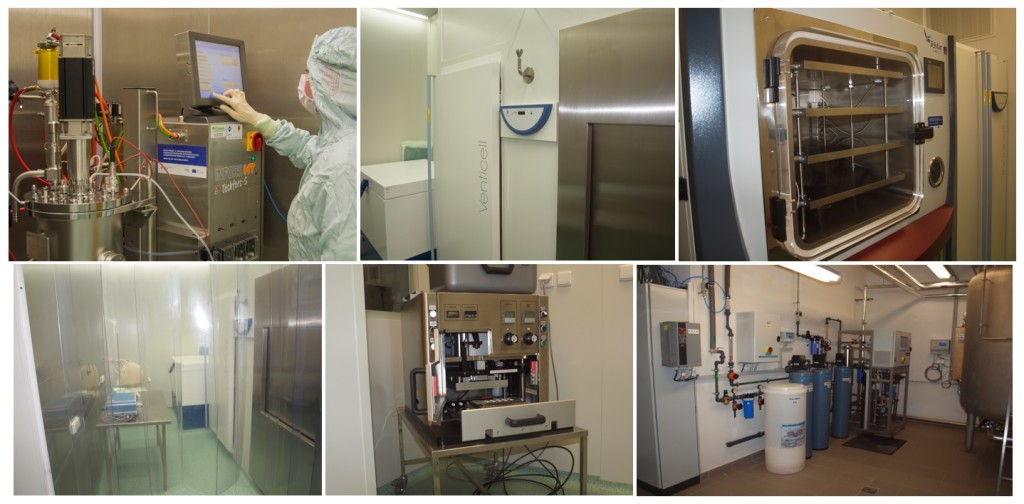
The workplace in Brno at the address Karásek 1, Brno – Řečkovice is equipped with clean rooms that meet the requirements for cleanliness classes A, B and C. The building structure, technological background, equipment and professional staff allow the workplace to be used even in the GMP regime. The technological equipment is oriented mainly to work with microbial material and to immunobiological issues in general. It is suitable not only for pharmaceutical production implementations, but also for pharmaceutical research and development both in-house and for a wide range of contractual activities.
The workplace in Roztoky is located on the premises of VUAB. This workplace serves as a R&D facilities for AUMED, a.s. The workplace is also equipped with research laboratories, including an analytical laboratory.
The workplace at 5. května 301, 294 71 Benátky nad Jizerou was opened in early 2024. This workplace is equipped with research laboratories, including a microbiological and analytical laboratory. The workplace is also equipped with clean rooms of cleanliness class D, which are used both in-house and for a wide range of contractual activities. There is also a reserve space in the place, which we would like to use in the future for the production of a new medicinal product containing human transfer factor as an effective medicinal substance. The new medicinal product is based on the results of our own research activities and is currently in the clinical trials phase.
We are continuing a century-old tradition of Czech immunology and vaccination
AUMED, a.s. builds upon a nearly century-long tradition of Czech immunobiological and vaccine research and production. Our know-how is the result of a generationally-built legacy, with roots tracing back to the beginnings of the Czechoslovak Republic.
The history began in 1918 with the goal of building a sovereign public health system, including the systematic development and production of strategic vaccination sera. This vision led to the establishment of the State Health Institute (SZÚ), which, with support from the Rockefeller Foundation and state investments, opened on November 5, 1925. Under the leadership of MUDr. Bohuslav Feierabend, the SZÚ quickly produced life-saving sera and, by 1933, was exporting 56 types of sera and vaccines, including those against tetanus, diphtheria, and scarlet fever. Even at that time, the production of bacteriophages was significant.
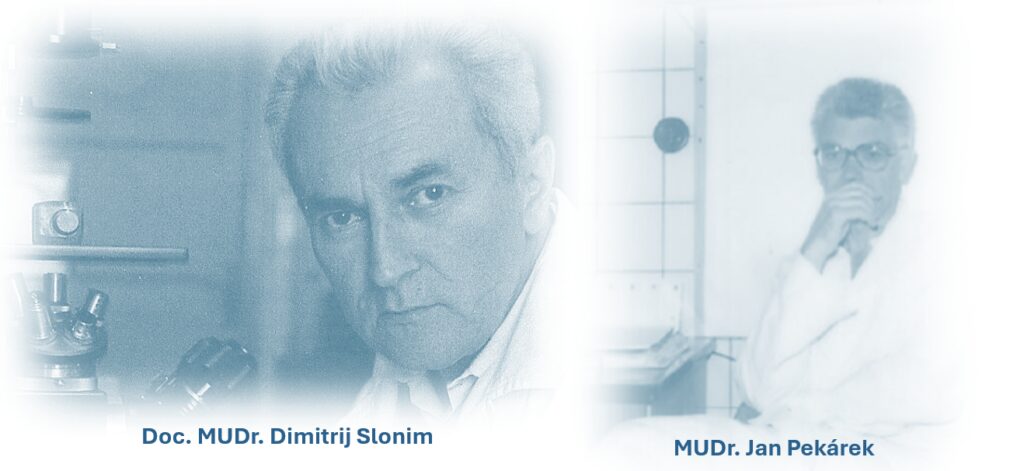
After the war, in 1958, the Institute of Sera and Vaccines (ÚSOL) was established. Key figures were active here, such as Assoc. Prof. MUDr. Dimitrij Slonim, whose team was the first in the world to implement the mass application of the poliomyelitis vaccine, leading to the complete eradication of polio in Czechoslovakia. In the 1980s, MUDr. Jan Pekárek focused on cellular immunity research and developed the preparation Transfer Factor SEVAC, later known as Immodin. ÚSOL also produced a range of vaccines against rabies, measles, mumps, and their combinations.
After 1989, ÚSOL underwent privatization and transformation into SEVAPHARMA, a.s., which continued the extensive production of bacterial and viral vaccines (including TRIVIVAC, accepted by UNICEF), allergens, Immodin, and bacteriophages (STAFAL).
However, the further development of Sevapharma, a.s. was negatively affected by the owner’s managerial interventions, which resulted in insolvency and bankruptcy. At this critical moment, it was crucial to prevent the loss of this nearly century-old national scientific treasure—the unique know-how and its custodians. AUMED, a.s., under the leadership of RNDr. Juraj Vronka, therefore decided to save this tradition. The priority was to keep the specialized teams together, as they were the custodians of knowledge in vaccines, bacterial preparations, bacteriophages, and immunomodulators. AUMED thus became the new home for the key employees who carry this legacy forward.
In 2017, AUMED, a.s. initiated two key projects building on the tradition of MUDr. Pekárek: “Transfer factor – development and research of a new dosage form” and “Research and development of a new vaccine against whooping cough.”
Currently, in the field of bacterial vaccines, we are developing an easily applicable immunization preparation for mucosal immunity against B. pertussis and a new vaccine against Staphylococcus aureus. In the field of cellular immunity, we have developed a new medicinal product containing human transfer factor, which builds on the Immodin tradition; to bring it to market, we founded AUMED Immunology a.s. in 2022. Our expertise in bacteriophage production is being modernized and applied, for example, in dermocosmetics (Phage Glow), where it serves to address problems such as acne, eczema, and growing antibiotic resistance.
AUMED, a.s. thus systematically utilizes its inherited and generationally-built know-how to develop new solutions in immunology and vaccination, thereby ensuring the continuity of the Czech scientific and manufacturing tradition.
More information can be found in the article ‘A century-long tradition of Czech immunology and vaccination: From the Institute of Sera and Vaccines (ÚSOL) to AUMED, a.s.‘, link to the article here.
SUBSIDIARY COMPANIES
Under the company AUMED, a.s. also include AUMED Immunology a.s. and AUMED Pharma a.s., which were founded with their own business goals. You can learn more about these companies and their goals here:
COMPANY PHILOSOPHY
Our research is primarily aimed at improving the health of the entire population, which is the cornerstone of the society's function.
Excessive use of antibiotics in healthcare has led to the rise of multi-resistant and pan-resistant strains of bacteria. This has created a serious problem in the field of veterinary and human medicine in the fight against infectious diseases. The same problem are residues in foods that have a negative impact on human health, especially negative for the immune system. Today’s interest is mainly in non-antibiotic and non-generic preparations based on bacteriophage probiotics and enzyme therapy.
Research and subsequent implementation in these areas would reduce the waste burden on the environment, have a positive impact on regional growth and create new jobs with the possibility of involving university students.
RESEARCH PROJECTS
ATOPIC ECZEMA
Development of a preparation based on a cleansing spray intended for the supportive treatment of the skin in case of atopic eczema.
NASAL MICROBIOME
Development of a preparation based on polyvalent phages and compatible probiotics designed for the treatment and decolonization of the nasal cavity in inflammations caused by staphylococcal strains (specifically targeting the MRSA strain).
DIAGNOSTICS
AUMED a.s. was also involved in the fight against the Covid-19 pandemic. In cooperation with Protean s.r.o. and Institute of Molecular and Translational Medicine, AUMED a.s. launched a modern diagnostics of SARS-CoV-2 virus under the name AUMED test RT-LAMP Assay SARS-CoV-2.
AUMED, a.s. launched also its own self-sampling set based on the principle of gargling of the oral cavity and pharynx.
With this step, the company significantly expanded its portfolio of professional activities!
PRODUCTION
The company AUMED carries out contract manufacturing of pharmaceutical and cosmetic products.
PHAGE GLOW
Dermocosmetic preparations specifically targeted at acneic and eczematous skin.
EXPERT AND ADVISORY ACTIVITIES
AUMED, a.s. focuses its professional activities on highly specific immunobiological issues.
AUMED, a.s. solves research projects in the field of bacterial vaccines (pertussis vaccine – Bordetella pertussis) and immunomodulators (transfer factor innovation).
In addition to its own research and development activities, it uses its expertise for consulting, advisory and training activities for external entities. These are highly specified pharmaceutical professional activities with an emphasis on GMP (Good Manufacturing Practice), which are actively required by external companies.
References:
Hematology and Blood Transfusion Institute – training and expert activities of AUMED a.s. personnel concerning the implementation of GMP in the area of ATMP (Advanced Therapy Medicinal Products). Consultations with SÚKL. Company audits participation.
Institutul Pasteur Romania – experts activities concerning the construction project of a new manufacturing areal for pharmaceutical manufacture.
Co Antigen Ltd, Research and Prouction Center the Republic of Kazakhstan, Almaty – expert activities concerning the implementation of GMP in pharmaceutical manufacture. Personnel training. Practical training. Representation before government authority.
EBRD – European Bank for Reconstruction and Development – AUMED a.s. personnel are registered as expert counsel to the bank in the area of pharmaceutical issues for small companies. For this purpose, they are being retained by the Bank of London for specific projects realized by the bank abroad.
ICRC (International Clinical Research Center St. Anne’s Faculty – consultancy activities for the implementation of GMP in the entire process – specifically, project participation, construction realization consultation, technological assembly implementation, validation issues, documents creation, personnel training etc.
Macromolecular Chemistry Institute AV ČR – BIOCEV department – (Biotechnology and Biomedicine Centre of the Academy of Sciences and Charles University in Vestec). Consultancy activities for the implementation of GMP in the entire process – specifically, project participation, SÚK project consultation, construction realization consultation, technological assembly implementation, validation issues, documents creation, personnel training etc.